Thomas Alva Edison (February 11, 1847 – October 18, 1931) was an American inventor, scientist and businessman who developed many devices that greatly influenced life around the world, including the phonograph, the motion picture camera, and a long-lasting, practical electric light bulb. Dubbed "The Wizard of Menlo Park" by a newspaper reporter, he was one of the first inventors to apply the principles of mass production and large teamwork to the process of invention, and therefore is often credited with the creation of the first industrial research laboratory.
Edison is considered one of the most prolific inventors in history, holding 1,093 U.S. patents in his name, as well as many patents in the United Kingdom, France and Germany. He is credited with numerous inventions that contributed to mass communication and, in particular, telecommunications. His advanced work in these fields was an outgrowth of his early career as a telegraph operator. Edison originated the concept and implementation of electric-power generation and distribution to homes, businesses, and factories - a crucial development in the modern industrialized world. His first power plant was on Manhattan Island, New York.
Early life

Birthplace of Thomas Edison

Historical marker of Edison's birthplace in Milan, Ohio Thomas Edison was born in Milan, Ohio, and grew up in Port Huron, Michigan. He was the seventh and last child of Samuel "The Iron Shovel" Edison, Jr. (1804–1896) (born in Marshalltown, Nova Scotia, Canada) and Nancy Matthews Elliott (1810–1871). He considered himself to be of Dutch ancestry.[1] In school, the young Edison's mind often wandered, and his teacher, the Reverend Engle, was overheard calling him "addled." This ended Edison's three months of official schooling. Edison recalled later, "My mother was the making of me. She was so true, so sure of me; and I felt I had something to live for, someone I must not disappoint." His mother then home schooled him.[2] Much of his education came from reading R.G. Parker's School of Natural Philosophy and The Cooper Union. Edison developed hearing problems at an early age. The cause of his deafness has been attributed to a bout of scarlet fever during childhood and recurring untreated middle ear infections. Around the middle of his career Edison attributed the hearing loss to being struck on the ears by a train conductor when his chemical laboratory in a boxcar caught fire and he was thrown off the train in Smiths Creek, Michigan, along with his apparatus and chemicals. In his later years he modified the story to say the injury occurred when the conductor, in helping him onto a moving train, lifted him by the ears.[3][4] Edison's family was forced to move to Port Huron, Michigan, when the railroad bypassed Milan in 1854,[5] but his life there was bittersweet. He sold candy and newspapers on trains running from Port Huron to Detroit, as well as vegetables that he sold to supplement his income. This began Edison's long streak of entrepreneurial ventures as he discovered his talents as a businessman. These talents eventually led him to found 14 companies, including General Electric, which is still in existence, and one of the largest publicly traded companies in the world.[6]
Telegrapher
Edison became a telegraph operator after he saved three-year-old Jimmie MacKenzie from being struck by a runaway train. Jimmie's father, station agent J.U. MacKenzie of Mount Clemens, Michigan, was so grateful that he trained Edison as a telegraph operator. Edison's first telegraphy job away from Port Huron was at Stratford Junction, Ontario, on the Grand Trunk Railway.[7] In 1866, at the age of 19, Thomas Edison moved to Louisville, Kentucky, where, as an employee of Western Union, he worked the Associated Press bureau news wire. Edison requested the night shift, which allowed him plenty of time to spend at his two favorite pastimes—reading and experimenting. Eventually, the latter pre-occupation cost him his job. One night in 1867, he was working with a battery when he spilled sulfuric acid onto the floor. It ran between the floorboards and onto his boss's desk below. The next morning Edison was fired.[8]
One of his mentors during those early years was a fellow telegrapher and inventor named Franklin Leonard Pope, who allowed the impoverished youth to live and work in the basement of his Elizabeth, New Jersey home. Some of Edison's earliest inventions were related to telegraphy, including a stock ticker. His first patent was for the electric vote recorder, (U. S. Patent 90,646),[9] which was granted on June 1, 1869.[10]
Marriages and children
On December 25, 1871, Edison married 16-year-old Mary Stilwell, whom he had met two months earlier as she was an employee at one of his shops. They had three children:
- Marion Estelle Edison (1873–1965), nicknamed "Dot"[citation needed]
- Thomas Alva Edison, Jr. (1876–1935), nicknamed "Dash"[citation needed]
- William Leslie Edison (1878–1937)[11]
Mary Edison died on August 9, 1884, possibly from a brain tumor.[12]
On February 24, 1886, at the age of thirty nine, Edison married 20-year-old Mina Miller in Akron, Ohio.[13] She was the daughter of inventor Lewis Miller, co-founder of the Chautauqua Institution and a benefactor of Methodist charities. They also had three children:
- Madeleine Edison (1888–1979), who married John Eyre Sloane.[14][15]
- Charles Edison (1890–1969), who took over the company upon his father's death and who later was elected Governor of New Jersey.[16] He also took charge of his father's experimental laboratories in West Orange.
- Theodore Edison (1898–1992), the only family member to get a college degree (MIT Physics 1923), and had over 80 patents to his credit.
Mina outlived Thomas Edison, dying on August 24, 1947.[17][18]
Beginning his career

Photograph of Edison with his phonograph, taken by
Mathew Brady in 1877
Thomas Edison began his career as an inventor in Newark, New Jersey, with the automatic repeater and his other improved telegraphic devices, but the invention which first gained him fame was the phonograph in 1877. This accomplishment was so unexpected by the public at large as to appear almost magical. Edison became known as "The Wizard of Menlo Park," New Jersey, where he lived. His first phonograph recorded on tinfoil around a grooved cylinder and had poor sound quality. The tinfoil recordings could only be replayed a few times. In the 1880s, a redesigned model using wax-coated cardboard cylinders was produced by Alexander Graham Bell, Chichester Bell, and Charles Tainter. This was one reason that Thomas Edison continued work on his own "Perfected Phonograph."
Menlo Park (1876-1881)
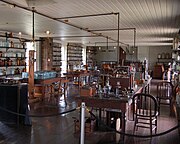
Edison's Menlo Park Laboratory, removed to
Greenfield Village in Dearborn, Michigan. (Note the organ against the back wall)

Thomas Edison's first successful light bulb model, used in public demonstration at Menlo Park, December 1879

U.S. Patent#223898: Electric-Lamp. Issued January 27, 1880.
Edison's major innovation was the first industrial research lab, which was built in Menlo Park, New Jersey. It was built with the funds from the sale of Edison's quadruplex telegraph. After his demonstration of the telegraph, Edison was not sure that his original plan to sell it for $4,000 to $5,000 was right, so he asked Western Union to make a bid. He was surprised to hear them offer $10,000,[citation needed] which he gratefully accepted. The quadruplex telegraph was Edison's first big financial success, and Menlo Park became the first institution set up with the specific purpose of producing constant technological innovation and improvement. Edison was legally attributed with most of the inventions produced there, though many employees carried out research and development work under his direction. His staff was generally told to carry out his directions in conducting research, and he drove them hard to produce results. The large research group, which included engineers and other workers, based much of their research on work done by others before them.
William J. Hammer, a consulting electrical engineer, began his duties as a laboratory assistant to Edison in December 1879. He assisted in experiments on the telephone, phonograph, electric railway, iron ore separator, electric lighting, and other developing inventions. However, Hammer worked primarily on the incandescent electric lamp and was put in charge of tests and records on that device. In 1880, he was appointed chief engineer of the Edison Lamp Works. In his first year, the plant under General Manager Francis Robbins Upton turned out 50,000 lamps. According to Edison, Hammer was "a pioneer of incandescent electric lighting".
Nearly all of Edison's patents were utility patents, which were protected for a 17-year period and included inventions or processes that are electrical, mechanical, or chemical in nature. About a dozen were design patents, which protect an ornamental design for up to a 14-year period. Like most patents, the inventions he described were improvements over prior art. The phonograph patent, on the other hand, was unprecedented as the first device to record and reproduce sounds.[19] Edison did not invent the first electric light bulb, but instead invented the first commercially practical incandescent light. Several designs had already been developed by earlier inventors including the patent he purchased from Henry Woodward and Mathew Evans, Moses G. Farmer,[20] Joseph Swan, James Bowman Lindsay, William E. Sawyer, Sir Humphry Davy, and Heinrich Göbel. Some of these early bulbs had such flaws as an extremely short life, high expense to produce, and high electric current drawn, making them difficult to apply on a large scale commercially. In 1878, Edison applied the term filament to the element of glowing wire carrying the current, although the English inventor Joseph Swan had used the term prior to this. Edison took the features of these earlier designs and set his workers to the task of creating longer-lasting bulbs. By 1879, he had produced a new concept: a high resistance lamp in a very high vacuum, which would burn for hundreds of hours. While the earlier inventors had produced electric lighting in laboratory conditions, dating back to a demonstration of a glowing wire by Alessandro Volta in 1800, Edison concentrated on commercial application, and was able to sell the concept to homes and businesses by mass-producing relatively long-lasting light bulbs and creating a complete system for the generation and distribution of electricity.
In just over a decade Edison's Menlo Park laboratory had expanded to occupy two city blocks. Edison said he wanted the lab to have "a stock of almost every conceivable material". A newspaper article printed in 1887 reveals the seriousness of his claim, stating the lab contained "eight thousand kinds of chemicals, every kind of screw made, every size of needle, every kind of cord or wire, hair of humans, horses, hogs, cows, rabbits, goats, minx, camels ...silk in every texture, cocoons, various kinds of hoofs, shark's teeth, deer horns, tortoise shell ...cork, resin, varnish and oil, ostrich feathers, a peacock's tail, jet, amber, rubber, all ores ..." and the list goes on.[21]
Over his desk, Edison displayed a placard with Sir Joshua Reynolds' famous quote: "There is no expedient to which a man will not resort to avoid the real labor of thinking."[22] This slogan was reputedly posted at several other locations throughout the facility.
With Menlo Park, Edison had created the first industrial laboratory concerned with creating knowledge and then controlling its application.
Carbon telephone transmitter
In 1877–1878, Edison invented and developed the carbon microphone used in all telephones along with the Bell receiver until the 1980s. After protracted patent litigation, in 1892 a federal court ruled that Edison—and not Emile Berliner—was the inventor of the carbon microphone. The carbon microphone was also used in radio broadcasting and public address work through the 1920s.
Electric light
Video clip of Thomas Edison talking about the invention of the light bulb, late 1920s
After many experiments with platinum and other metal filaments, Edison returned to a carbon filament. The first successful test was on October 22, 1879,[23] and lasted 40 hours. Edison continued to improve this design and by November 4, 1879, filed for U.S. patent 223,898 (granted on January 27, 1880) for an electric lamp using "a carbon filament or strip coiled and connected to platina contact wires".[24] Although the patent described several ways of creating the carbon filament including "cotton and linen thread, wood splints, papers coiled in various ways",[24] it was not until several months after the patent was granted that Edison and his team discovered a carbonized bamboo filament that could last over 1,200 hours.
Edison allegedly bought light bulb U.S. patent 181,613 of Henry Woodward that was issued August 29, 1876 and obtained an exclusive license to Woodward's Canadian patent. These patents covered a carbon rod in a nitrogen filled glass cylinder, and differed substantially from the first commercially practical bulb invented by Edison.[citation needed]
In 1878, Edison formed the Edison Electric Light Company in New York City with several financiers, including J. P. Morgan and the members of the Vanderbilt family. Edison made the first public demonstration of his incandescent light bulb on December 31, 1879, in Menlo Park. It was during this time that he said: "We will make electricity so cheap that only the rich will burn candles."[25]
George Westinghouse's company bought Philip Diehl's competing induction lamp patent rights (1882) for $25,000, forcing the holders of the Edison patent to charge a more reasonable rate for the use of the Edison patent rights and lowering the price of the electric lamp.[26]
On October 8, 1883, the U.S. patent office ruled that Edison's patent was based on the work of William Sawyer and was therefore invalid. Litigation continued for nearly six years, until October 6, 1889, when a judge ruled that Edison's electric light improvement claim for "a filament of carbon of high resistance" was valid. To avoid a possible court battle with Joseph Swan, whose British patent had been awarded a year before Edison's, he and Swan formed a joint company called Ediswan to manufacture and market the invention in Britain.
Mahen Theatre in Brno in what is now the Czech Republic, was the first public building in the world to use Edison's electric lamps, with the installation supervised by Edison's assistant in the invention of the lamp, Francis Jehl.[27]
Electric power distribution
Edison patented an electric distribution system in 1880, which was essential to capitalize on the invention of the electric lamp. On December 17, 1880, Edison founded the Edison Electric Illuminating Company. The company established the first investor-owned electric utility in 1882 on Pearl Street Station, New York City. It was on September 4, 1882, that Edison switched on his Pearl Street generating station's electrical power distribution system, which provided 110 volts direct current (DC) to 59 customers in lower Manhattan.
Earlier in the year, in January 1882 he had switched on the first steam generating power station at Holborn Viaduct in London. The DC supply system provided electricity supplies to street lamps and several private dwellings within a short distance of the station. On January 19, 1883, the first standardized incandescent electric lighting system employing overhead wires began service in Roselle, New Jersey.
War of currents
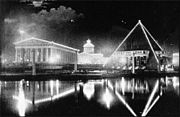
Extravagant displays of electric lights quickly became a feature of public events, as this picture from the 1897 Tennessee Centennial Exposition shows.
Edison's true success, like that of his friend Henry Ford, was in his ability to maximize profits through establishment of mass-production systems and intellectual property rights. This dampened the success of less profitable work by others who were focused on inventing longer-lasting high-efficiency technology.[28][29] George Westinghouse and Edison became adversaries because of Edison's promotion of direct current for electric power distribution instead of the more easily transmitted alternating current (AC) system invented by Nikola Tesla and promoted by Westinghouse. Unlike DC, AC could be stepped up to very high voltages with transformers, sent over thinner and cheaper wires, and stepped down again at the destination for distribution to users.
In 1887 there were 121 Edison power stations in the United States delivering DC electricity to customers. When the limitations of Direct Current (DC) were discussed by the public, Edison launched a propaganda campaign to convince people that Alternating Current (AC) was far too dangerous to use. The problem with DC was that the power plants could only economically deliver DC electricity to customers about one and a half miles from the generating station, so it was only suitable for central business districts. When George Westinghouse suggested using high-voltage AC instead, as it could carry electricity hundreds of miles with marginal loss of power, Edison waged a "War of Currents" to prevent AC from being adopted.
Despite Edison's contempt for capital punishment, the war against AC led him to become involved in the development and promotion of the electric chair as a demonstration of AC's greater lethal potential versus the "safer" DC. Edison went on to carry out a brief but intense campaign to ban the use of AC or to limit the allowable voltage for safety purposes. As part of this campaign, Edison's employees publicly electrocuted animals to demonstrate the dangers of AC;[30][31] AC electric currents, particularly near 60 Hz frequency, have a markedly greater potential for inducing fatal “Cardiac Fibrillation” than do DC currents.[32] On one of the more notable occasions, in 1903, Edison's workers electrocuted Topsy the elephant at Luna Park, near Coney Island, after she had killed several men and her owners wanted her put to death.[33] His company filmed the electrocution.
AC replaced DC in most instances of generation and power distribution, enormously extending the range and improving the efficiency of power distribution. Though widespread use of DC ultimately lost favor for distribution, it exists today primarily in long-distance high-voltage direct current (HVDC) transmission systems. Low voltage DC distribution continued to be used in high density downtown areas for many years but was replaced by AC low voltage network distribution in many central business districts. DC had the advantage that large battery banks could maintain continuous power through brief interruptions of the electric supply from generators and the transmission system. Utilities such as Commonwealth Edison in Chicago had rotary converters, also known as motor-generator sets , which could change DC to AC and AC to various frequencies in the early to mid-20th century. Utilities supplied rectifiers to convert the low voltage AC to DC for such DC loads as elevators, fans and pumps. There were still 1,600 DC customers in downtown New York City as of 2005, and service was only finally discontinued on November 14, 2007.[34] Most subway systems still are powered by direct current.
Fluoroscopy
Edison is credited with designing and producing the first commercially available fluoroscope, the machine that takes radiographs (colloquially known as "X-rays"). Until Edison discovered that calcium tungstate fluoroscopy screens produced brighter images than the barium platinocyanide screens originally used by Wilhelm Röntgen, the technology was only capable of producing very faint images. The fundamental design of Edison's fluoroscope is still in use today, despite the fact that Edison himself abandoned the project after nearly losing his own eyesight and seriously maiming his assistant, Clarence Dally. Dally had made himself an enthusiastic human guinea pig for the fluoroscopy project and in the process been exposed to a poisonous dose of radiation. He later died of injuries related to the exposure. In 1903, a shaken Edison said "Don't talk to me about X-rays, I am afraid of them."[35]
Work relations
Frank J. Sprague, a competent mathematician and former naval officer, was recruited by Edward H. Johnson and joined the Edison organization in 1883. One of Sprague's significant contributions to the Edison Laboratory at Menlo Park was to expand Edison's mathematical methods. Despite the common belief that Edison did not use mathematics, analysis of his notebooks reveal that he was an astute user of mathematical analysis conducted by his assistants such as Francis Upton, for example, determining the critical parameters of his electric lighting system including lamp resistance by a sophisticated analysis of Ohm's Law, Joule's Law and economics.[36]
Another of Edison's assistants was Nikola Tesla, who claimed that Edison promised him $50,000 if he succeeded in making improvements to his DC generation plants. Tesla claimed that several months later, when he had finished the work and asked to be paid, Edison said, "When you become a full-fledged American you will appreciate an American joke."[37] Tesla immediately resigned. With Tesla's salary of $18 per week, the payment would have amounted to over 53 years pay and the amount was equal to the initial capital of the company. Tesla resigned when he was refused a raise to $25 per week.[38] Although Tesla accepted an Edison Medal later in life and professed a high opinion of Edison as an inventor and engineer, this and other negative series of events concerning Edison remained with Tesla. The day after Edison died, the New York Times contained extensive coverage of Edison's life, with the only negative opinion coming from Tesla who was quoted as saying, "He had no hobby, cared for no sort of amusement of any kind and lived in utter disregard of the most elementary rules of hygiene" and that, "His method was inefficient in the extreme, for an immense ground had to be covered to get anything at all unless blind chance intervened and, at first, I was almost a sorry witness of his doings, knowing that just a little theory and calculation would have saved him 90% of the labour. But he had a veritable contempt for book learning and mathematical knowledge, trusting himself entirely to his inventor's instinct and practical American sense." When Edison was a very old man and close to death, he said, in looking back, that the biggest mistake he had made was that he never respected Tesla or his work.[39]
There were 28 men recognized as Edison Pioneers.
Media inventions
The key to Edison's fortunes was telegraphy. With knowledge gained from years of working as a telegraph operator, he learned the basics of electricity. This allowed him to make his early fortune with the stock ticker, the first electricity-based broadcast system. Edison patented the sound recording and reproducing phonograph in 1878. Edison was also granted a patent for the motion picture camera or "Kinetograph". He did the electromechanical design, while his employee W.K.L. Dickson, a photographer, worked on the photographic and optical development. Much of the credit for the invention belongs to Dickson.[23] In 1891, Thomas Edison built a Kinetoscope, or peep-hole viewer. This device was installed in penny arcades, where people could watch short, simple films. The kinetograph and kinetoscope were both first publicly exhibited May 20, 1891.[40]
On August 9, 1892, Edison received a patent for a two-way telegraph. In April 1896, Thomas Armat's Vitascope, manufactured by the Edison factory and marketed in Edison's name, was used to project motion pictures in public screenings in New York City. Later he exhibited motion pictures with voice soundtrack on cylinder recordings, mechanically synchronized with the film.
Officially the kinetoscope entered in Europe when the rich American Businessman Irving T. Bush (1869–1948) bought from the Continental Commerce Company of Franck Z. Maguire and Joseph D. Bachus a dozen machines. Bush placed from October 17, 1894 on the first kinetoscopes in London. At the same time the French company Kinétoscope Edison Michel et Alexis Werner bought these machines for the market in France. In the last three months of 1894 The Continental Commerce Company sold hundreds of kinetoscopes in Europe (i.e. the Netherlands and Italy). In Germany and in Austria-Hungary the kinetoscope was introduced by the Deutsche-österreichische-Edison-Kinetoscop Gesellschaft, founded by the Ludwig Stollwerck[41] of the Schokoladen-Süsswarenfabrik Stollwerck & Co of Cologne. The first kinetoscopes arrived in Belgium at the Fairs in early 1895. The Edison's Kinétoscope Français, a Belgian company, was founded in Brussels on January 15, 1895 with the rights to sell the kinetoscopes in Monaco, France and the French colonies. The main investors in this company were Belgian industrialists. On May 14, 1895 the Edison's Kinétoscope Belge was founded in Brussels. The businessman Ladislas-Victor Lewitzki, living in London but active in Belgium and France, took the initiative in starting this business. He had contacts with Leon Gaumont and the American Mutoscope and Biograph Co. In 1898 he also became shareholder of the Biograph and Mutoscope Company for France.[42]
In 1901, he visited the Sudbury area as a mining prospector, and is credited with the original discovery of the Falconbridge ore body. His attempts to actually mine the ore body were not successful, however, and he abandoned his mining claim in 1903.[43] A street in Falconbridge, as well as the Edison Building, which served as the head office of Falconbridge Mines, are named for him.
In 1902, agents of Thomas Edison bribed a theater owner in London for a copy of A Trip to the Moon by Georges Méliès. Edison then made hundreds of copies and showed them in New York City. Méliès received no compensation. He was counting on taking the film to US and recapture the huge cost of it by showing it throughout the US when he realized it has already been showing in the US by Edison. This bankrupted Méliès.[44] Other exhibitors similarly routinely copied and exhibited each others films.[45] To better protect the copyrights on his films, Edison deposited prints of them on long strips of photographic paper with the U.S. copyright office. Many of these paper prints survived longer and in better condition than the actual films of that era.[46]
Edison's favourite movie was The Birth of a Nation. He thought that talkies had "spoiled everything" for him. "There isn't any good acting on the screen. They concentrate on the voice now and have forgotten how to act. I can sense it more than you because I am deaf."[47]
In 1908, Edison started the Motion Picture Patents Company, which was a conglomerate of nine major film studios (commonly known as the Edison Trust). Thomas Edison was the first honorary fellow of the Acoustical Society of America, which was founded in 1929.
West Orange and Fort Myers (1886-1931)
Edison moved from Menlo Park after the death of Mary Stilwell and purchased a home known as "Glenmont" in 1886 as a wedding gift for Mina in Llewellyn Park in West Orange, New Jersey. In 1885, Thomas Edison bought property in Fort Myers, Florida, and built what was later called Seminole Lodge as a winter retreat. Edison and his wife Mina spent many winters in Fort Myers where they recreated and Edison tried to find a domestic source of natural rubber.
Henry Ford, the automobile magnate, later lived a few hundred feet away from Edison at his winter retreat in Fort Myers, Florida. Edison even contributed technology to the automobile. They were friends until Edison's death.

Thomas A. Edison Industries Exhibit, Primary Battery section, 1915

Henry Ford, Thomas Edison, Harvey Firestone—the fathers of modernity.
Ft. Myers,
Florida, February 11, 1929.
In 1928, Edison joined the Fort Myers Civitan Club. He believed strongly in the organization, writing that "The Civitan Club is doing things--big things--for the community, state, and nation, and I certainly consider it an honor to be numbered in its ranks."[48] He was an active member in the club until his death, sometimes bringing Henry Ford to the club's meetings.
The final years
Edison was active in business right up to the end. Just months before his death in 1931, the Lackawanna Railroad implemented electric trains in suburban service from Hoboken to Gladstone, Montclair and Dover in New Jersey. Transmission was by means of an overhead catenary system, with the entire project under Edison's guidance. To the surprise of many, he was at the throttle of the very first MU (Multiple-Unit) train to depart Lackawanna Terminal in Hoboken, driving the train all the way to Dover. As another tribute to his lasting legacy, the same fleet of cars Edison deployed on the Lackawanna in 1931 served commuters until their retirement in 1984, when some of them were purchased by the Berkshire Scenic Railway Museum in Lenox, MA. A special plaque commemorating the joint achievement of both the railway and Edison, can be seen today in the waiting room of Lackawanna Terminal in Hoboken, presently operated by New Jersey Transit.[49]
Edison was said to have been influenced by a fad diet that was popular in the day to that in his last few years "the only liquid he consumed was a pint of milk every three hours".[23] He is reported to have believed this diet would restore his health. However, this tale is doubtful. In 1930, the year before Edison died, Mina said in an interview about him that "Correct eating is one of his greatest hobbies." She also said that during one of his periodic "great scientific adventures", Edison would be up at 7:00, have breakfast at 8:00, and be rarely home for lunch or dinner, implying that he continued to have all three.[47]
Edison became the owner of his Milan, Ohio, birthplace in 1906. On his last visit, in 1923, he was shocked to find his old home still lit by lamps and candles.
Thomas Edison died of complications of diabetes on October 18, 1931, in his home, "Glenmont" in Llewellyn Park in West Orange, New Jersey, which he had purchased in 1886 as a wedding gift for Mina. He is buried behind the home.[50][51]
Mina died in 1947. Edison's last breath is reportedly contained in a test tube at the Henry Ford Museum. Ford reportedly convinced Charles Edison to seal a test tube of air in the inventor's room shortly after his death, as a memento. A plaster death mask was also made.[52]
Views on politics, religion and metaphysics
Historian Paul Israel has characterized Edison as a "freethinker".[23] Edison was heavily influenced by Thomas Paine's The Age of Reason.[23] Edison defended Paine's "scientific deism", saying, "He has been called an atheist, but atheist he was not. Paine believed in a supreme intelligence, as representing the idea which other men often express by the name of deity."[23] In an October 2, 1910 interview in the New York Times Magazine, Edison stated:
Nature is what we know. We do not know the gods of religions. And nature is not kind, or merciful, or loving. If God made me – the fabled God of the three qualities of which I spoke: mercy, kindness, love – He also made the fish I catch and eat. And where do His mercy, kindness, and love for that fish come in? No; nature made us – nature did it all – not the gods of the religions.[53]
Edison was called an atheist for those remarks, and although he did not allow himself to be drawn into the controversy publicly, he clarified himself in a private letter: "You have misunderstood the whole article, because you jumped to the conclusion that it denies the existence of God. There is no such denial, what you call God I call Nature, the Supreme intelligence that rules matter. All the article states is that it is doubtful in my opinion if our intelligence or soul or whatever one may call it lives hereafter as an entity or disperses back again from whence it came, scattered amongst the cells of which we are made."[23]
Nonviolence was key to Edison's moral views, and when asked to serve as a naval consultant for World War I, specified he would only work on defensive weapons and later noted, "I am proud of the fact that I never invented weapons to kill." Edison's philosophy of nonviolence extended to animals as well, about which he stated: "Nonviolence leads to the highest ethics, which is the goal of all evolution. Until we stop harming all other living beings, we are still savages."[54]
Tributes
Places named for Edison
Several places have been named after Edison, most notably the town of Edison, New Jersey. Thomas Edison State College, a nationally-known college for adult learners, is in Trenton, New Jersey. Two community colleges are named for him: Edison State College in Fort Myers, Florida, and Edison Community College in Piqua, Ohio.[55] There are numerous high schools named after Edison; see Edison High School.
The City Hotel, in Sunbury, Pennsylvania, was the first building to be lit with Edison's three-wire system. The hotel was re-named The Hotel Edison, and retains that name today.
Three bridges around the United States have been named in his honor (see Edison Bridge).
Museums and memorials
In West Orange, New Jersey, the 13.5 acre (5.5 ha) Glenmont estate is maintained and operated by the National Park Service as the Edison National Historic Site.[citation needed] The Thomas Alva Edison Memorial Tower and Museum is in the town of Edison, New Jersey.[citation needed] In Beaumont, Texas, there is an Edison Museum, though Edison never visited there.[citation needed] The Port Huron Museum, in Port Huron, Michigan, restored the original depot that Thomas Edison worked out of as a young newsbutcher. The depot has been named the Thomas Edison Depot Museum.[citation needed] The town has many Edison historical landmarks, including the graves of Edison's parents, and a monument along the Saint Clair River. Edison's influence can be seen throughout this city of 32,000. In Detroit, the Edison Memorial Fountain in Grand Circus Park was created to honor his achievements. The limestone fountain was dedicated October 21, 1929.[citation needed]
Companies bearing Edison's name
Awards named in honor of Edison
The Edison Medal was created on February 11, 1904, by a group of Edison's friends and associates. Four years later the American Institute of Electrical Engineers (AIEE), later IEEE, entered into an agreement with the group to present the medal as its highest award. The first medal was presented in 1909 to Elihu Thomson and, in a twist of fate, was awarded to Nikola Tesla in 1917. It is the oldest award in the area of electrical and electronics engineering, and is presented annually "for a career of meritorious achievement in electrical science, electrical engineering or the electrical arts."
In the Netherlands, the major music awards are named the Edison Award after him.
The American Society of Mechanical Engineers concedes the Thomas A. Edison Patent Award to individual patents since 2000.[56]
Honors and awards given to Edison
In 1887, Edison won the Matteucci Medal. In 1890, he was elected a member of the Royal Swedish Academy of Sciences.
He was ranked thirty-fifth on Michael H. Hart's 1978 book The 100, a list of the most influential figures in history. Life magazine (USA), in a special double issue in 1997, placed Edison first in the list of the "100 Most Important People in the Last 1000 Years", noting that the light bulb he promoted "lit up the world". In the 2005 television series The Greatest American, he was voted by viewers as the fifteenth-greatest.
In 1983, the United States Congress, pursuant to Senate Joint Resolution 140 (Public Law 97 - 198), designated February 11, Edison's birthday, as National Inventor's Day.
Other items named after Edison
The United States Navy named the USS Edison (DD-439), a Gleaves class destroyer, in his honor in 1940. The ship was decommissioned a few months after the end of World War II. In 1962, the Navy commissioned USS Thomas A. Edison (SSBN-610), a fleet ballistic missile nuclear-powered submarine. Decommissioned on December 1, 1983, Thomas A. Edison was stricken from the Naval Vessel Register on April 30, 1986. She went through the Navy’s Nuclear Powered Ship and Submarine Recycling Program at Bremerton, Washington, beginning on October 1, 1996. When she finished the program on December 1, 1997, she ceased to exist as a complete ship and was listed as scrapped.
In popular culture
Thomas Edison has appeared in popular culture as a character in novels, films, comics and video games. His prolific inventing helped make him an icon and he has made appearances in popular culture during his lifetime down to the present day. His history with Nikola Tesla has also provided dramatic tension and is a theme returned to numerous times.


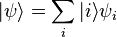
 s specify the different quantum "alternatives" available (technically, they form an eigenvector basis) and the ψi are the probability amplitude coefficients, which are complex numbers.

 (as defined above) and similarly
  are the coefficients of the final state of the system. * is the complex conjugate so that
  , etc.
 to
to  via an intermediate state

 ; these extra quantum terms represent interference between the different
  intermediate "alternatives". These are consequently known as the quantum interference terms, or cross terms. This is a purely quantum effect and is a consequence of the non-additivity of the probabilities of quantum alternatives.


